
Martyrs of the Byzantine Catholic Church

Blessed Bishop-Martyr Theodore G. Romzha
(1911 - 1947)
In the Carpathian Highlands of Eastern Europe in the village of Velikyj Bychkiv, Theodore George Romzha was born on April 14, 1911. His childhood was one of extreme poverty which in no way embittered him towards life. While fishing he liked to read which nourished his imagination and sharpened his already keen mind. It was from his mother that he inherited a genuine piety. He liked to pray and took an active part in church services.
Although materially poor, he was spiritually rich and desired to become a priest. His pastor assisted him in entering the seminary. It was there that he gained the admiration and respect of both his fellow students and faculty members. His bishop later sent him to Rome to pursue further studies. His was ordained to the priesthood in Rome on Christmas Day 1936. Shortly afterwards, he was drafted into the army medical corps as a commissioned lieutenant for one year. Following his discharge, his bishop appointed him as an administrator to a small parish. He was a good pastor and the people admired him greatly.
Fr. Romzha was one of the most dedicated priests of the Mukachevo Eparchy, and therefore was assigned as the spiritual director and professor at the seminary.
On September 24, 1944, he was consecrated as bishop at the age of 33 thus making him the youngest bishop in the Catholic Church. A month later, the Soviet army marched into the cities of Uzhorod and Mukachevo. Bishop Romzha learned from his first contact with the Soviets that he could not trust them. In anticipation of open hostility, Bishop Romzha maintained personal contact with his clergy and faithful. Between 1945 and 1947, he personally visited every parish in the eparchy. When the Soviets confiscated his automobile, he travelled thousands of miles by horse and buggy. Finally, the decision was made to liquidate him.
Following the celebration of Christ the King on October 26, 1947 in the small parish of Lavki, while returning back to Mukachevo, his cart was assailed by a Soviet military vehicle. The severely injured bishop was taken to the local hospital where his was poisoned days later on November 1st. The late Pope Blessed John Paul II beatified him in June 2001. Let us imitate his zealous faith and continue to pray fervently for his Canonization.
Blessed Bishop-Martyr Basil Hopko
(1904 - 1976)
Basil Hopko was born on April 21, 1904 in the Rusyn Village of Hrabske near Bardejov, Eastern Slovakia. His father passed away in 1905 leaving his mother Anna to travel to America for employment while leaving Basil and his sister, Mary, to be raised by her parents.
Basil’s uncle, Father Demetrius Petrenko, took on the responsibility for Basil’s education and was a great influence on him. In 1922 young Basil enrolled into the eparchial seminary in Preshov. Following his second year, he was drafted into the army. There he would gather all the Rusyn soldiers together and take them to Sunday services. Upon completing his military service, he completed seminary studies in 1928. He became very ill, and promised Christ through devotion of His Most Sacred Heart that if he would recover, he would be ordained in celibacy. The Lord heard his prayer and on February 3, 1929 he was ordained to the holy priesthood by Bishop Paul P. Gojdich.

Fr. Basil served his pastoral assignments faithfully displaying a great love for the poor, workers and Rusyn youth. Foreseeing a political overturn in Czechoslovakia in the autumn of 1946, Bishop Godjich petitioned Rome that Father Hopko serve as his auxiliary bishop. The request was granted. On April 28, 1950, the Communist government seized complete control of Czechoslovakia and liquidated the Preshov Eparchy. Bishop Hopko was imprisoned and tortured.
Many years of imprisonment and harsh treatment took a final toll on his health. In the Spring of 1968, a liberalization of the Communist regime took place and the government agreed to re-establish the Church. He became chaplain to the Sisters Servants of Mary Immaculate who also took care of him. On Friday, July 23, 1976 following a light lunch, and being helped in an easy chair, he gave up his spirit to the Lord whom he loved and faithfully served. The late Pope Blessed John Paul II beatified him in September 2004. His relics were transferred to the Presov Cathedral, and rest beneath the altar adjacent to the chapel of Blessed Paul Gojdich. Let us eagerly imitate his faith and continue to fervently pray for his Canonization.
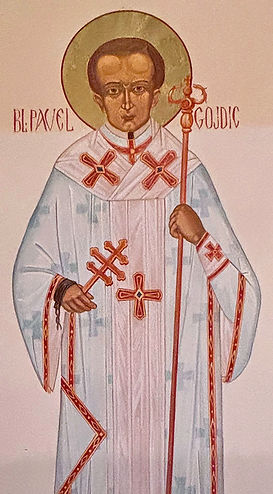
Blessed Bishop-Martyr Peter P. Gojdich
(1888 - 1960)
Peter Gojdich was born to a priestly family in Sharis County of today’s Eastern Slovakia on July 17, 1888. At an early age his only desire was to become a celibate priest. Following his ordination for the Preshov Eparchy in August 1911, and serving a short tenure of pastoral work, he was assigned to teach religious education to the youth in the city. The young students found him to be an inspiring leader and an approachable spiritual father. He was also a chancery official, but afterwards felt drawn to a more peaceful and prayerful life.
He entered the Basilian Order to become a Monk. It was at this time that he changed his name to Paul signifying a new vocation that he was embarking upon. His heart’s desire was shortly lived when he was summoned to Rome to be ordained a Bishop in March 1927. Although he protested against such an honor, he submitted through obedience. The late Pope Blessed Pius XI presented him with a pectoral cross prophetically stating, “This cross is only a symbol of those heavy crosses that you will have to carry in your Episcopal ministry. But take courage, my son, the good Lord will help you carry them with dignity and love.”
In April 1950, Communism spread through the Preshov Eparchy. The atheistic government condemned him for his loyalty to the Catholic Church and sentenced him to prison. While in prison he excelled in holiness, and was reportedly gifted with the extra-ordinary gifts of bilocation, levitation and the stigmata of the Lord. He prayed for only two favors: (1) to pass peacefully to the Lord on his birthday, and (2) to have a priest near his side to anoint him with the Sacrament. Both requests were answered on July 17, 1960 just after 12 o’clock midnight. He was buried quickly in an uncommon grave with only a number to signify the placement of his mortal remains.
He was beatified by the late Pope Blessed John Paul II on November 4, 2001. His relics were transferred to the Preshov Cathedral where they remain for veneration to this day. In recent years, he was posthumously awarded with the prestigious decree “Righteous Among the Nations” by the Hebraic Community due to his role in saving thousands of Jewish people from extermination during World War II. Let us imitate his uncompromising faith and whole-heartedly pray for his immediate Canonization.
Blessed Petro Pavlo Oros
(1913 - 1953)
"Petro Pavlo Oros served God all his life. He is a shining example of deep spiritual love for Jesus to Christ." - Bishop Milan Sasik, CM
The Servant of God Petro (Peter) Oros was born on July 14, 1917 in the village of Biri (Hungary) in the family of a Greek Catholic priest. In 1919, the family moved to Transcarpathia. He was orphaned at age nine, and taken in by another priestly family, the Sabovs, in Skoarstke. In 1937, Peter entered the Uzhgorod Theological Seminary, and on June 28, 1942, he was ordained as a celibate priest. He began his pastoral activity in the village of Veliki Komyati in Vinohradiv district. On December 19, 1944, Bishop Theodore Romzha consecrated him as one of the secret auxiliary bishops of the Mukachevo eparchy; he was only twenty-seven years old.

In 1946, he was appointed to a parish in the village of Bilky in the Irshava district. In 1948, the local authorities resorted to various methods of influence in order to persuade Father Peter to convert to Russian Orthodoxy. Because he was one of the few celibate priests, they suspected that he might be a secret bishop. He, like all other priests who did not give in to their convictions, was forbidden to perform pastoral work. But he remained faithful to his vocation, and created a group of priests who took refuge in the mountains and continued to secretly serve the Greek-Catholic believers in Irshava and Vinohradiv districts. For five years the young bishop carried on his work, sometimes completely alone, from a cabin in the forest. His co-workers included Father Ivan Margitič (later auxiliary bishop of Mukachevo), Ivan Roman and Ivan Čengeri.
At the beginning of 1953, he was caught, arrested and sent to Uzhhorod, to the KGB detention center, where he was detained for more than two weeks. Due to Stalin’s death and the rapid changes in the USSR, the police were not sure if they should hold him, and he was released. In the summer of 1953, a policeman tried to arrest Father Peter near Imstichevo, but he was lucky enough to escape. In constant danger, without rest, sleep and safe shelter, the tragic day of martyrdom was approaching for Father Peter.
On the eve of the feast of the Assumption of the Blessed Virgin Mary, August 27, 1953, (Old Calendar) in the village of Veliki Komyati, he served a well-attended Holy Liturgy in the cemetery. On the same day, he went on foot to the railway station, with Catherine Stanko, who went to buy his ticket. Here he was arrested by a fanatic communist policeman who began to take him in the direction of the village. This policeman executed the bishop near a roadside cross. At the foot of the cross, the militiaman ordered the young bishop, who was only thirty-six, "Pray, because it is your end." Father Petro knelt down and partook of the Eucharist, which he had with him. Two shots followed: first he shot the priest in his knee, and then in the head. Mrs. Stanko ran to call people for help. The mayor also came running, and denounced the militiaman for assassinating the bishop. He, told the mayor, "Shut up, because I'll do the same to you." The militiaman later boasted to his friends that he had received a reward of 500 rubles for this brutal execution. While he lay dying the bishop gave Catherine Stanko a list of liturgy intentions from his pocket; the last one read “soul of Petro Pavlo Oros” for he had known his death was coming.
Today Blessed Petro Oros’ relics repose in a chapel next to the church in Bilky, his last parish. A youth pilgrimage comes to the site every year. His beatification was approved in August 2022 and after several delays he was beatified in September 2025.

The Servant of God, Bishop Alexander Chira
(1897 - 1983)
Coming from a large priestly family in the Maramorosh District of the Carpathian Highlands, the Servant of God, Alexander Chira was born on January 17, 1897. He was the oldest of 7 children. As an intellectually gifted young man, he graduated with honors in 1915. Following in the steps of his father, Cornelius, he felt a divine to the priesthood. Completing the theological formation program he was ordained a priest in Uzhorod on the Feast of Saint Nicholas, December 19, 1920.
In 1924, he succeeded Father Basil Takach as spiritual director of the Uzhorod Seminary, and was the professor of Church History, Canon Law and was a gifted Orator. He was elevated to the episcopacy in 1944 and Bishop Romzha appointed him as his Vicar General. His diplomatic ability and iron clad logic frustrated all Soviet attempts to discredit the young Bishop Romzha in the eyes of the faithful.
He dedicated himself wholeheartedly to the defense of the Mukachevo Eparchy and its faithful against Soviet aggression. Following Bishop Romzha’s violent death in 1947, the Soviets promised him honors if he would bring the eparchy under the jurisdiction of the Moscow patriarch. His answer was decisive: “I was born a Greek Catholic, and I also want to die a Greek Catholic!” During the night of February 10, 1949, the Soviets incarcerated him and tried him for “sabotage and slander against the Soviet Union.” When they learned that he was secretly ordained a bishop they tried him again in Kiev for “treason.” As a “traitor of the Soviet Union” he was sentenced to 25 years of imprisonment with the loss of his civil rights. He was deported to Central Siberia to work in the coal mines. In 1956, the government granted general amnesty to all political prisoners. He returned to his native village and secretly continued pastoral work.
During Christmas of 1957, he was apprehended by the Soviet police and sentenced to 5 years of forced labor to the mining labor camps near Karaganda in Central Asia. He was ill-treated, tortured and forbidden to do any pastoral work, but under the cover of nightfall, he continued to celebrate the Divine Liturgy, hear Confessions, baptize children, marry young people and take care of the sick and dying. Bishop Chira died in exile in his sleep on May 26, 1983, and was buried by the wall of the church he helped to build. Let us imitate the faith he portrayed and fervently pray for his Beatification.